
About SSS 2026
SSS is an international forum for researchers and practitioners in the design and development of distributed systems with a focus on systems that are able to provide guarantees on their structure, performance, and/or security in the face of an adverse operational environment.
Where
Gothenburg, Sweden
When
9-11 October 2026
Keynotes
Here are our keynote speakers
Marina Papatriantafilou
Chalmers University of Technology, Sweden

Petar Popovski
Professor, Aalborg University, Denmark

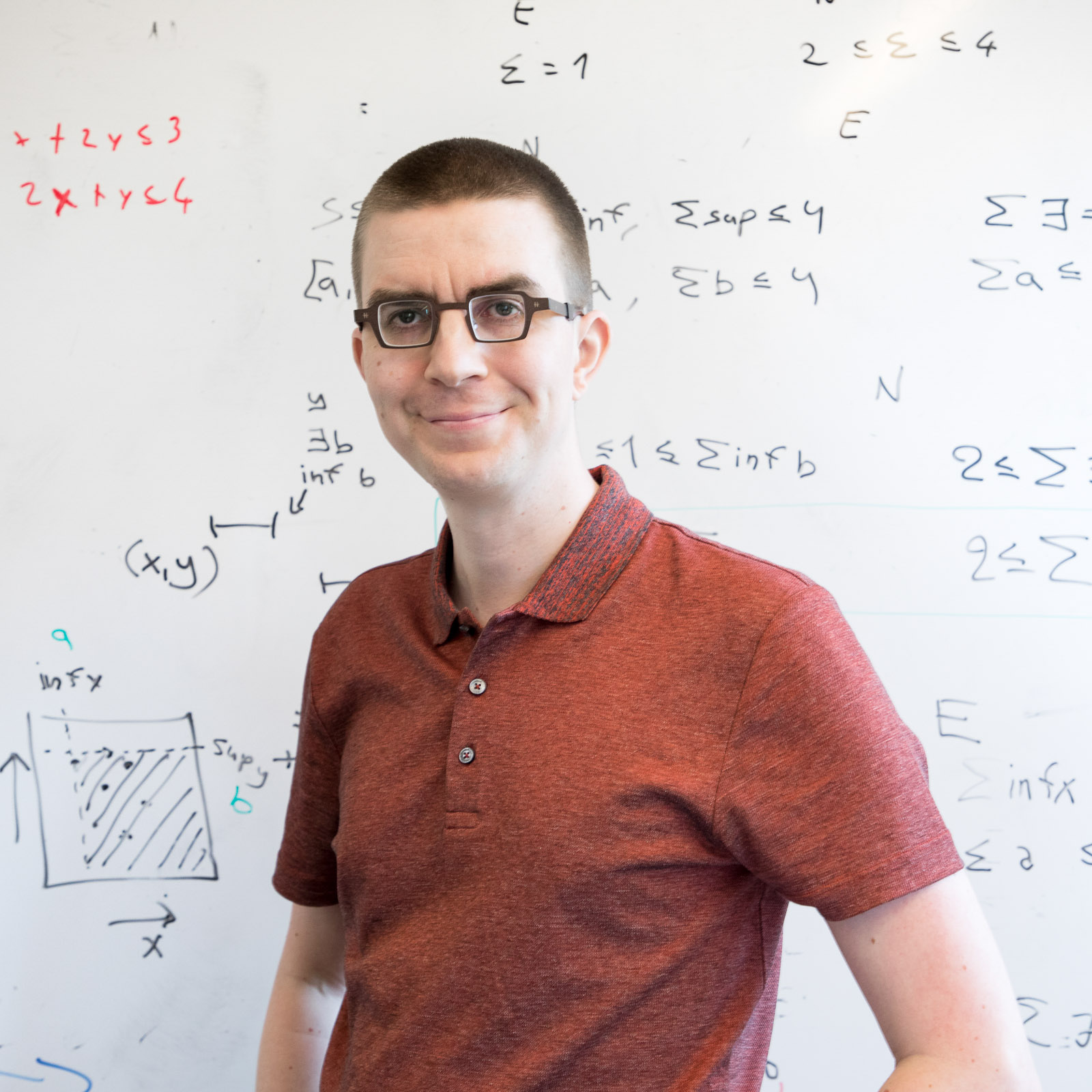
Jukka Suomela
Full Professor, Aalto University, Finland
Student Scholarships
Partial waivers of registration fees and partial reimbursement of travel expenses are available for students, primarily targeting student authors of accepted papers. The application period runs between June 10, 2026 and August 4, 2026
Registration
Registration for SSS 2026 is now open. Register through the Chalmers Webshop .
All prices include 25% VAT.
Registration is required to participate in SSS 2026.
Author registration. Each accepted paper must be associated with a separate Regular/Author registration by September 9, 2026, 23:59 CEST. The registering author must register using the Regular/Author category, even if the author is a student. Student registration does not satisfy the author-registration requirement. Student authors are encouraged to apply for an SSS 2026 Student Scholarship, which provides partial support for conference registration and travel expenses. Scholarship applications must be submitted by August 4, 2026 through the SSS 2026 website. During registration, authors are requested to specify the paper ID of the accepted paper for which they are registering.
Discounted prices are available for early registrations until 9 September (AoE). An accompanying person may attend the SSS banquet for an extra 600/800 SEK (until 9 Sept. / from 10 Sept.).
Regular/Author
Until 9 Sept.:Includes:
- Conference attendance
- Coffee breaks
- Lunches
- Banquet
Student
Until 9 Sept.:Includes:
- Conference attendance
- Coffee breaks
- Lunches
- Banquet
Student scholarships. Students who have applied for an SSS 2026 Student Scholarship should wait for the scholarship decision before registering.
Registration information. Participants will be asked to provide their name, optional title, required affiliation, email address, country, dietary restrictions, accessibility requirements, and, for authors, paper ID or paper IDs. The affiliation will appear on the name badge. If a title is provided, it will also appear on the badge.
Payment. Registration is completed securely through the Chalmers Webshop using a credit or debit card.
Cancellation policy. Registration fees are non-refundable. A registration may, however, be transferred to another participant by contacting the organizers.
Visa invitation letters. Invitation letters are available upon request after registration and payment. Please contact the organizers if you require one.
Event Venue
SSS 2026 will take place in Scaniasalen at the Chalmers Student Union, Teknologgatan 2, 412 58 Göteborg. Google Maps.
Hotels
Hotel availability around SSS 2026, especially for the night of October 8, may be limited. Participants are encouraged to book early. Special booking links, discount codes and booking instructions are available upon request from the SSS 2026 local organizers.
Hotell Heden
Sten Sturegatan 1, Göteborg, approximately 1.1 km from the conference venue
(about 15 minutes on foot).
SEK 950 per room per night for single or twin rooms,
October 8–12. Breakfast and VAT included.
Comfort Hotel Panorama
Eklandagatan 51–53, Göteborg, approximately 600 m from the conference venue
(about 9 minutes on foot).
12% discount for October 8–12.
Indicative discounted rates when arranged were approximately
SEK 1,296 for a compact double room and SEK 1,384 for a standard double room,
both for single occupancy. Rates are dynamic and subject to availability.
Elite Plaza Hotel
Västra Hamngatan 3, Göteborg, approximately 2 km from the conference venue.
Standard single room: SEK 1,378 per night
Deluxe single room: SEK 1,528 per night
Additional guest: SEK 200 per night
Breakfast and VAT included. Reservations are subject to availability.
Gothia Towers
Mässans Gata / Korsvägen, Göteborg, approximately 1.8 km from the conference venue.
Gothia Towers is particularly convenient for participants arriving late in the evening:
Korsvägen is the first central Gothenburg stop of the airport coach from
Göteborg Landvetter Airport, and the hotel is located directly beside the stop.
Available for October 9–11 only; the hotel is fully booked
before October 9.
Standard View: SEK 1,250 per room per night
Sky View: SEK 1,515 per room per night
Breakfast and VAT included. Reservations are subject to availability.
Travel Information
By air
Göteborg Landvetter Airport (GOT) is approximately 20 km from central Gothenburg. Airport coaches operated by Vy Flygbussarna and FlixBus connect the airport with Gothenburg. Flygbussarna stops at Korsvägen, which is convenient for Chalmers, as well as at Göteborg Central Station. Taxis are also available outside the airport terminal. See Landvetter Airport transportation information.
By train
Göteborg Central Station has train connections with, among others, Stockholm, Copenhagen and Oslo. From the central station, the conference venue can be reached easily by local tram or bus.
Local transportation.
Gothenburg's buses and trams are operated by Västtrafik. The easiest way to plan journeys and buy tickets is through the Västtrafik To Go app. Contactless payment cards can also be used to buy adult single tickets directly on buses and trams within Gothenburg.
Important Dates
First Deadline
- Paper Submission Deadline: March 31, 2026 (11:59 PM AoE)
- Acceptance Notification: April 30, 2026
- Camera-Ready Copy Due: July 31, 2026
Second Deadline
- Paper Submission Deadline: May 22, 2026 (11:59 PM AoE)
- Acceptance Notification: June 30, 2026
- Camera-Ready Copy Due: July 31, 2026
Third Deadline
- Abstract Submission Deadline: July 25, 2026 (11:59 PM AoE)
- Paper Submission Deadline: July 26, 2026 (11:59 PM AoE)
- Acceptance Notification: August 31, 2026
- Camera-Ready Copy Due: September 10, 2026
Call for Papers
SSS is an international forum for researchers and practitioners in the design and development of distributed systems with a focus on systems that are able to provide guarantees on their structure, performance, and/or security in the face of an adverse operational environment. The symposium encourages submissions of original contributions on both fundamental research and practical applications concerning topics in the symposium tracks:
Track A. Stabilization and Locality in Distributed Computing
- Stabilizing Systems
- Proof labelling schemes
- Graph Algorithms
- Graph-theoretic concepts for communication networks
- Social and Peer-to-Peer Networks
- LOCAL/CONGEST models
- Communication complexity
- Game-theory and economical aspects of distributed computing
- Dynamic networks, time-varying graphs, evolving graphs
Track B. Time, Safety, and Security in Distributed Computing
- Concurrent and fault-tolerant algorithms
- Synchronization protocols
- Shared and transactional memory
- Blockchain technologies and cryptocurrencies
- Formal methods, semantics and verification of distributed systems
- Secure multi-party computation and cryptographic distributed protocols
- Privacy-enhancing technologies and anonymity
- Post-quantum and information theoretic cryptography and security
Track C. Moving and Computing
- Mobile agents
- Autonomous mobile robots
- Mobile sensor networks
- Mobile ad-hoc networks
- Population protocols
- Nature-inspired computing
- Programmable particles, nanoscale robots, biological systems, and related new models
Track D. Distributed Artificial Intelligence and Machine Learning
- Fault-tolerant distributed training
- Scheduling and resource allocation in ML clusters
- Consistency models for distributed ML
- Communication efficient distributed machine learning
- Edge Cloud co-training
- ML-aware storage systems
- Data flow optimization of ML pipelines
- Energy efficient distributed ML
- Learning augmented consensus
- Predictive failure detection
- Convergence of asynchronous optimization
- Lower bounds for distributed learning
Track E. Real-World Distributed Systems and Operational Challenges
This track welcomes contributions that bridge distributed systems research with practical deployment, empirical evaluation, and operational experience.
- Deployment and implementation of distributed algorithms and protocols
- Real-world case studies of distributed and dependable systems, including operational IoT and cyber-physical deployments such as automotive infrastructures
- Industry-driven challenges in distributed systems
- Empirical evaluation and benchmarking of distributed systems
- Comparative and reproducibility studies for distributed systems
- Large-scale configuration, orchestration, and systems management
- Reliability, resilience, and fault tolerance in deployed systems and cyber-physical infrastructures
- Security and privacy protection for operational distributed systems and infrastructures
- Scalability bottlenecks and debugging experiences in real deployments
- Operational lessons learned from distributed systems in practice
Conference Model
There will be THREE non-overlapping deadlines, and thus three submission rounds. Papers that are rejected at an early round (1 or 2) may be reworked, corrected, enhanced, and resubmitted at a later round (2 or 3), if wished by the authors. Of course, accepted papers at an early round are definitely accepted and should not be submitted again at a later round. In case of resubmission, reviews from the previously submitted round will be transmitted to the reviewers of the resubmission round.
Paper Submission
Papers are to be submitted electronically through HotCRP. All submissions must conform to the formatting instructions of Springer LNCS series. Each submission must be an original work written in English, in PDF format. Note that the website for submitting paper for the third deadline will be activated after July 1 when the review process of round 2 is completed
Double-blind Review
All submissions must be anonymous. We use a somewhat relaxed implementation of double-blind peer review: you are free to disseminate your work through arXiv and other online repositories and give presentations on your work as usual. However, please make sure you do not mention your own name or affiliation in the submission, and please do not include obvious references in the text that reveal your identity. A reviewer who has not previously seen the paper should be able to read it without accidentally learning the identities of the authors. Please feel free to ask the general co-chairs if you have any questions about the double-blind policy of SSS 2025.
Submissions
There are two types of submissions: regular papers and brief announcements.
- A regular submission must not exceed 15 pages (including the title, abstract, figures, and excluding references). Additional necessary details for an expert to verify the main claims of the submission may be included in a clearly marked appendix if extra space is needed.
- A brief announcement submission must not exceed 5 pages including everything.
Publication
Regular papers and brief announcements will be included in the conference proceedings. Conference proceedings will be published by Springer.
Special Issue
Extended and revised versions of selected papers will be considered for a special issue of an international journal (under negociation).
Paper Award
Prizes will be given to the best regular paper and best student regular paper.
A regular paper is eligible for the best student paper if at least one of its authors is a full-time student at submission time.
Authors should clearly indicate whether their submission is eligible to be considered for the best student regular paper award (e.g., using a \thanks in the title).
The PC may decline to confer awards or may split awards.
Organization
General Co-Chairs
- Sandeep Kulkarni (Michigan State University, USA)
- Elad Schiller (Chalmers University of Technology, Sweden)
Steering Committee
- Anish Arora (Ohio State University, USA)
- Stéphane Devismes (Université de Picardie Jules Verne, France)
- Shlomi Dolev (Ben-Gurion University of the Negev, Israel)
- Sayaka Kamei (Hiroshima University, Japan)
- Sandeep Kulkarni (Michigan State University, USA)
- Toshimitsu Masuzawa (Osaka University, Japan)
- Elad Michael Schiller (Chalmers University of Technology, Sweden)
- Sébastien Tixeuil (Chair) (Sorbonne Université, France)
Advisory Committee
- Sukumar Ghosh (University of Iowa, USA)
- Franck Petit (Sorbonne Université, France)
- Ted Herman (University of Iowa, USA)
In Memory of
- Ajoy Kumar Datta
- Edsger W. Dijkstra
- Mohamed Gouda
Program Committee
Track A. Stabilization and Locality in Distributed Computing
- Stéphane Devismes (Chair) (Université de Picardie Jules Verne, France)
- Arnaud Casteigt (University of Geneva, Switzerland)
- Antonella Del Pozzo (CEA, France)
- Anaïs Durand (Université Clermont Auvergne, France)
- Olga Goussevskaia (Federal University of Minas Gerais, Brazil)
- Michiko Inoue (Nara Institute of Science and Technology, Japan)
- Sayaka Kamei (Hiroshima University, Japan)
- Duong Nguyen (University of Wyoming, USA)
- Sathya Peri (Indian Institute of Technology Hyderabad, India)
- Gokarna Sharma (Kent-State University, USA)
- Yuichi Sudo (Hosei University, Japan)
Track B. Time, Safety, and Security in Distributed Computing
- John Augustine (Chair) (Indian Institute of Technology, India)
- Doina Bein (California State University, USA)
- Gregory Chockler (University of Surrey, UK)
- Antonio Cruciani (Aalto University, Finland)
- Roy Friedman (Technion, Israel)
- Thorsten Götte (University of Hamburg, Germany)
- Neeraj Mittal (University of Texas at Dallas, USA)
- Achour Mostefaoui (Rennes University, France)
- Christian Scheideler (Paderborn University, Germany)
- KC Sivaramakrishnan (IIT Madras, India)
- Amitabh Trehan (Durham University, UK)
Track C. Moving and Computing
- Anissa Lamani (Chair) (University of Strasbourg, France)
- Doina Bein (California State University, USA)
- Quentin Bramas (University of Strasbourg, France)
- David Ilcinkas (University of Bordeaux, France)
- Peter Kling (University of Applied Sciences Darmstadt, Germany)
- Evangelos Kranakis (Carleton University, Canada)
- Partha Sarathi Mandal (IIT Guwahati, India)
- Fukuhito Ooshita (Fukui University of Technology, Japan)
- Giuseppe Prencipe (University of Pisa, Italy)
- Giovanni Viglietta (University of Aizu, Japan)
Track D. Distributed Artificial Intelligence and Machine Learning
- Anish Arora (Chair) (Ohio State University, USA)
- Debabrota Basu (Inria, France)
- Yung-Fu Chen (Ohio State University, USA)
- Dhrubojyoti Roy, (Microsoft, USA)
- Gagan Raj Gupta (IIT Bhilai, India)
- Jayson Boubin (Binghamton University, USA)
- Ali Anwar (University of Minnesota, USA)
- Bapi Chatterjee (IIIT Delhi, India)
- Jie Liu (Stony Brook, USA)
Track E. Real-World Distributed Systems and Operational Challenges
- Magnus Almgren (Chair) (Chalmers University of Technology, Sweden)
- Khushan Adatiya (Google)
- David De Andres Martinez (Polytechnic University of Valencia, Spain)
- Marcello Cinque (University of Naples Federico II, Italy)
- Zbigniew Kalbarczyk (University of Illinois at Urbana-Champaign, USA)
- Dan Kim (The University of Queensland, Australia)
- Roberto Palmieri (Lehigh University, USA)
- Peng Liu (Penn State University, USA)
- Antonio Pecchia (Università degli Studi del Sannio, Italy)
- Manojit Saha Sardar (Amazon Web Services)
- Behrooz Sangchoolie (RISE, Sweden)
- Marcus Völp (University of Luxembourg, Luxembourg)
- Valentin Tudor (Ericsson, Sweden)
- Katinka Wolter (FU Berlin, Germany)